Why horses - BECAUSE CONNECTION ASKS US TO BE PRESENT

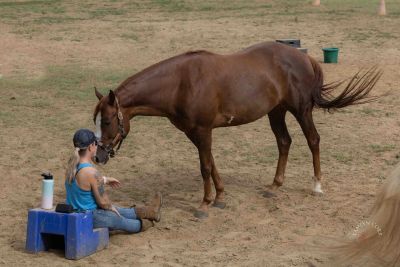
Sentient Beings Meeting in a Shared Experience
Horses bring something powerful and distinctive to experiential learning, coaching, psychotherapy, mindfulness, relationship work, and body-based awareness—not because they possess magical healing abilities, simply mirror our emotions, or exist as tools to calm, regulate, or fix us.
Horses are sentient beings with their own emotions, experiences, physical needs, social relationships, preferences, boundaries, and freedom of choice. The value of working alongside them begins with respecting who they are, not only what people may receive from them. At Withers & Wellness, the horse is an active participant whose communication and well-being matter independently of the human’s goals.
The Nature of the Horse
Horses are social herd animals whose evolution included the need to notice and respond quickly to possible changes or threats in their environment. Because they can be vulnerable to predators, they are highly attentive to movement, sound, scent, proximity, pressure, and changes within the herd. Flight is one possible response, but horses may also pause and assess, freeze, investigate, defend themselves, seek support from another horse, or create distance. Their response depends on the individual horse, their physical comfort, learning history, social relationships, and what is happening in that moment.
Much of a horse’s communication is subtle. A shift in weight, movement of an ear, change in breathing, tightening or softening around the eyes, turning away, approaching, or requesting more space may all provide information. When we slow down enough to notice these signals, we often become more aware of our own pace, posture, focus, intentions, and expectations.
Nervous Systems Sharing Space
Horses and humans both have autonomic nervous systems that continually respond to information from within the body, relationships, and the environment. The sympathetic branch helps mobilize the body when action may be needed and is often associated with fight or flight, although activation may also appear as heightened attention, tension, movement, defensiveness, or freezing. The parasympathetic branch supports functions associated with rest, digestion, recovery, and restoration. Neither branch is inherently good or bad. Both horses and humans need the ability to mobilize when necessary and return toward greater ease when conditions allow.
When horses and humans share space, each arrives with their own nervous system, history, needs, and present-moment experience. They may influence and respond to one another, but the horse is not responsible for regulating the person, and the person is not there to force the horse into a calm state. Co-regulation is better understood as a relational possibility between two living nervous systems, not something the horse provides as a service. Sometimes one being softens and the other responds. Sometimes one becomes alert and the other notices. Sometimes connection looks like closeness, and sometimes greater comfort requires distance.
Similar, but Not the Same
Horses and humans are both mammals with biological systems involved in emotion, memory, learning, relationship, arousal, and survival. Both can form bonds, remember previous interactions, experience stress, learn through experience, and communicate through the body. However, we do not experience or interpret the world in exactly the same way.
Humans frequently use language, abstract thought, analysis, memory, and personal stories to assign meaning to what happens. Horses experience an interaction through equine senses, physical comfort, social needs, learning history, emotional state, and the surrounding environment. Horses can notice and respond to human posture, facial expressions, voices, scent, attention, and previous experiences, but that does not mean they can read our minds or understand the personal story behind every emotion.
A horse walking away does not automatically mean rejection. An approach does not necessarily mean the horse has chosen the person who needs them most. A yawn does not prove that emotional healing has occurred. A horse may be responding to another horse, a sound, an insect, discomfort, curiosity, learned behavior, or a need for space.
Sometimes horses are simply being horses.
Part of this work is learning to separate what we directly observe from the story we may be creating about it. That practice can develop curiosity, self-awareness, clearer communication, and greater respect for a perspective beyond our own.
Horses Are More Than Mirrors
Horses are often described as mirrors of human emotion. While they may respond to our posture, movement, tension, focus, proximity, or behavior, describing the horse only as a mirror overlooks their individuality and their own experience.
Rather than immediately asking, “What is this horse reflecting about me?” we can become curious about what we are actually observing, what may be happening for the horse, what assumptions we are making, and how we can respond in a way that respects both horse and human.
A horse’s behavior may offer meaningful information without needing to become a symbolic interpretation of the person.
Attunement, Communication and Choice
Attunement means recognizing another being’s communication and responding in a way that lets them know they were noticed. With horses, this may mean pausing after a subtle response, softening our touch, changing our position, reducing pressure, or offering more space. When a horse recognizes that their communication affects what happens next, trust, participation, and bonding may deepen. The person is no longer simply doing something to the horse; the horse is allowed to participate in the conversation.
Humans can experience something meaningful in that process as well. Learning to recognize the horse’s signals may help us notice our own physical sensations, stress responses, boundaries, needs, and patterns of communication. We learn that connection does not develop by overriding boundaries. It develops through listening and responding.
The horse is not required to approach, remain close, accept touch, cooperate with every activity, or provide an emotional experience for the participant. The human is also not required to touch the horse, disclose personal information, complete every activity, or push beyond their comfort level. Freedom of choice does not interfere with connection. It is one of the conditions that allows genuine connection to develop. Sometimes connection looks like closeness. Sometimes it looks like offering distance. Sometimes it is a shared pause, a subtle response, or a decision to try something differently.
What the Research Suggests
Heart rate variability, or HRV, is one way researchers explore autonomic nervous-system activity. Research involving physiological coherence and horse-human interaction has examined whether heart rate and HRV patterns may change or become synchronized during certain types of contact.
Some studies suggest that bidirectional physiological influence or synchronization can occur during particular horse-human interactions. However, findings vary depending on the individual horses and people, their relationship, the activity, the environment, and the methods used.
This does not mean every horse regulates every person or that simply standing near a horse automatically creates calm, healing, or nervous-system synchronization. It does support continued curiosity about the ways horses and humans perceive, influence, and respond to one another.
At Withers & Wellness, we honor both the possibilities and the limits of this research. We do not ask horses to carry responsibility for human healing. We create conditions in which both horse and human can communicate, make choices, and experience what may emerge through respectful relationship.
Why Experiential Work Can Be Powerful
Horses help bring learning out of the purely intellectual and into a lived experience. A person may understand the idea of boundaries but experience it differently when a horse clearly asks for space. They may know that slowing down is important but only recognize their own urgency when they notice themselves rushing an interaction. They may talk about trust but discover that trust cannot be demanded.
The horse does not provide a diagnosis or deliver a predetermined lesson. The shared interaction gives participants something real to observe, respond to, and reflect upon in the present moment. That experience may create insight related to relationships, communication, leadership, stress, expectations, self-awareness, or life outside the session.
Honoring the horse as a partner
The Horse’s Experience Matters
The human benefits of equine-assisted services cannot come at the expense of the horse. A quiet horse is not automatically a comfortable horse, and a horse standing still is not necessarily relaxed or choosing the interaction. One visible behavior cannot tell us everything about what the horse is experiencing.
We consider the whole horse: behavior, body language, physical comfort, environment, social relationships, learning history, and freedom to communicate. The horse’s needs matter even when they interrupt the plan. Their request for space is communication, their choice not to engage still provides information, and their “no” deserves to be heard.
The horse does not need to heal us, calm us, carry our emotions, or make our experience meaningful. We are also not there to fix, control, or interpret everything about the horse. Instead, horse and human meet as two living beings with their own nervous systems, histories, needs, boundaries, and choices.
There is no one to fix and nothing to prove. There is simply an opportunity to notice, listen, respond, and experience what becomes possible when both horse and human are allowed to have a voice.

Mind. Body. Connection.
Horses have a way of helping us come back to what is real.
They can remind us to slow down. To listen. To notice. To reconnect with the body. To communicate with more clarity. To let go of what no longer serves us. And sometimes, to see a new possibility that was there all along.
Whether you are seeking support for yourself, a meaningful experience for your group, or greater comfort and connection for your horse, there is a place to begin here.